

The Complete Guide to Hiring ML Engineers from India for US Companies in 2025


Listen to this article
The US machine learning talent market is broken, and most CTOs know it.
Roles sit open for four to six months. Shortlists are thin. The candidates who do make it through either want $300k+ or disappear into a better offer the week before their start date. Meanwhile, the features don't ship, the models don't train, and the competitive gap widens.
This is why a growing number of US companies — from YC-backed seed-stage startups to Series C SaaS businesses — are hiring ML engineers from India. Not because it's cheap (though it is significantly cheaper). Because it works. The talent is there, the quality is real, and when the hiring process is run correctly, the time from intake call to first commit is measured in weeks, not quarters.
This guide covers everything you need to make that work: how to structure the search, what to pay, how to vet candidates remotely, how to handle compliance, and what separates the engagements that succeed from the ones that quietly fall apart.
Why US Companies Are Hiring ML Engineers from India Right Now
The US ML talent shortage is not a temporary blip. The number of machine learning and AI roles posted in the US has grown faster than the domestic talent supply for years running. Universities produce a fraction of what the market demands. The candidates who do graduate from top programs have their pick of offers from FAANG, well-funded startups, and established tech companies — all competing at the same salary bands.
For a 100-person B2B SaaS company trying to build its first serious ML infrastructure, competing in that market on equal terms is nearly impossible. You're not just competing on salary. You're competing on brand recognition, equity upside, and the perceived prestige of the work.
India changes that equation. The country produces more than 1.5 million STEM graduates annually. Its top engineering institutions — IITs, NITs, BITS Pilani — have long produced world-class ML talent. And unlike the US market, supply is closer to demand, which means the hiring timeline is dramatically shorter and the cost is dramatically lower.
The numbers tell the story plainly. A mid-level ML engineer in the US commands $160,000–$220,000 in total compensation. The equivalent profile in India costs $25,000–$45,000 annually. For a startup running lean, that difference funds two or three additional hires.
The timezone concern — which comes up in almost every conversation about India-based hiring — is real but manageable. Most India-based ML engineers working with US teams operate on a partial overlap model: they start their day at 6–7pm IST, which gives four to five hours of live collaboration with US East Coast teams. The work that doesn't need synchronous communication — model training, data pipeline work, code review — happens during India business hours and is ready when the US team wakes up.
What Roles Can You Realistically Hire From India
Not every ML role maps cleanly to an India hire. Here's an honest breakdown of what works and what requires more consideration.
What works well:
LLM engineers and GenAI specialists are in strong supply in India right now. The cohort of engineers who built their skills on the open-source LLM ecosystem — fine-tuning, RAG architecture, evaluation frameworks, prompt engineering at the API level — is large and growing. These are often engineers in their late 20s to mid-30s who have been working on AI-adjacent problems and pivoted hard into LLM engineering over the last two years.
MLOps engineers are another strong hire from India. Roles that involve infrastructure — model serving, pipeline orchestration, monitoring, retraining workflows — translate well to remote work and don't require heavy real-time collaboration with product teams.
Data scientists with ML responsibilities — the kind of role that combines analytical work with model building — are abundant and well-priced. Many Indian engineers in this profile have strong foundations in statistics and mathematics, partly a product of the engineering education system's emphasis on quantitative fundamentals.
NLP engineers and computer vision specialists are available, though the pool narrows at the senior end. For mid-level roles in these specialisations, India is a strong market.
Where it's more complicated:
Roles that require heavy day-to-day collaboration with non-technical stakeholders — an ML engineer who needs to sit in constant product meetings, present to customers, or act as a bridge between engineering and go-to-market — are harder to staff remotely. Not because the talent doesn't exist, but because the timezone and communication overhead adds friction that pure engineering roles don't have.
Highly specialised research roles — if you genuinely need someone with a PhD working on novel architectures — tend to concentrate in the US, UK, and a handful of European research hubs. India has strong research talent, but the deepest research profiles often end up at US universities or labs.
What It Actually Costs: The Full Picture
The salary savings are real. But the full cost of an India-based ML hire includes more than the salary number, and any company that hasn't thought through the complete picture will hit surprises.
Salary ranges (2025, USD equivalent):
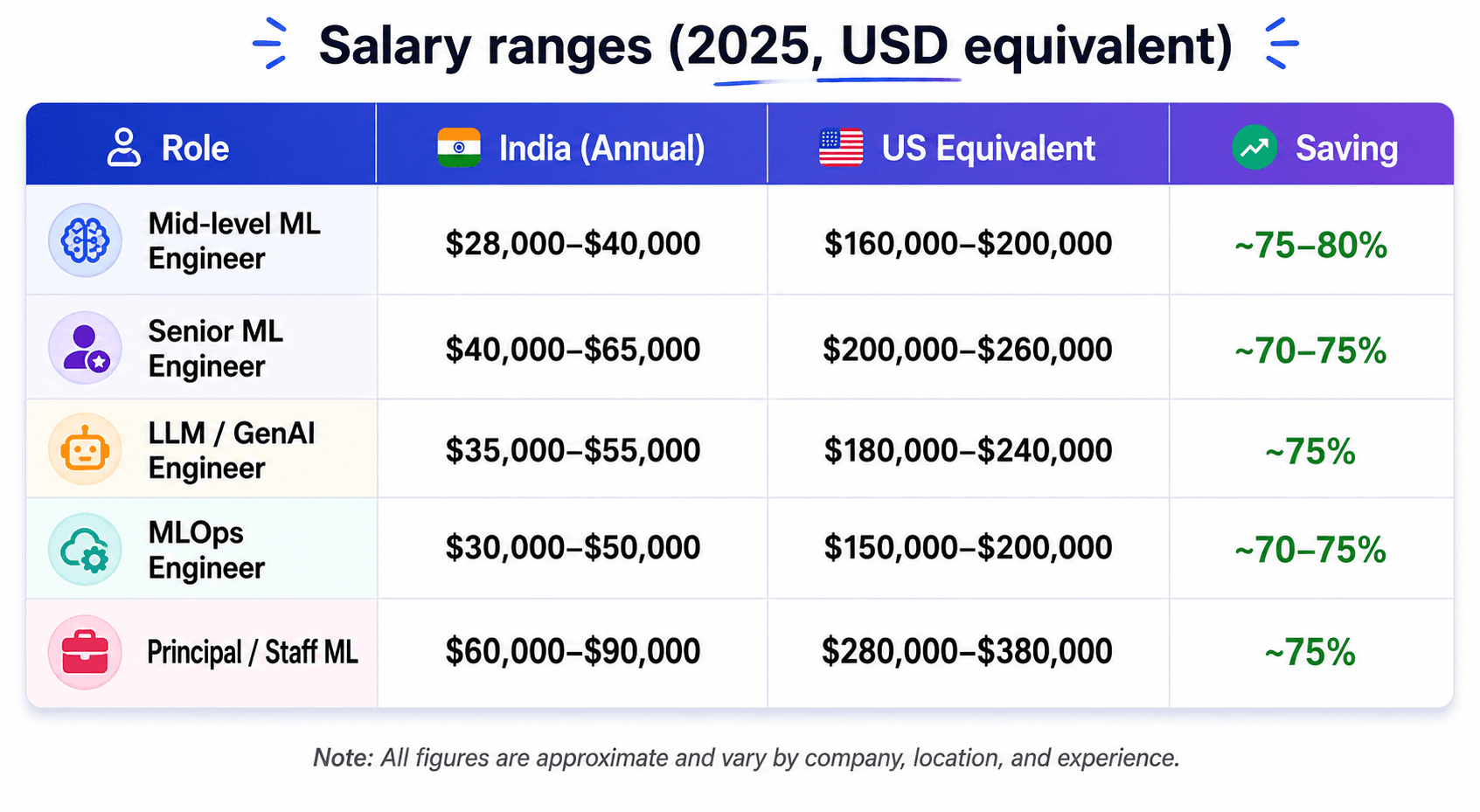
These are take-home equivalents, not CTC. Indian compensation packages include components — provident fund contributions, gratuity, various allowances — that inflate the CTC number relative to the actual cash the engineer receives. When comparing offers, look at net take-home and equity separately.
The additional costs you need to budget:
Employer of Record (EOR) fees run $200–$500 per month per employee, depending on the provider. EOR is how most US companies legally hire Indian talent without establishing a local entity — the EOR is the legal employer in India, you direct the work. This is the compliant path. Skipping it and hiring as an independent contractor works until it doesn't, and the tax and compliance exposure when it unravels is significant.
Staffing agency fees, if you use one, typically run 15–25% of first-year salary. For a $35,000/year hire, that's a one-time placement fee of $5,250–$8,750. Against the savings of not paying a US salary, this is recovered in weeks.
Equipment, software licenses, and tooling are the same regardless of where the engineer sits. Budget for these as you would for any hire.
The total all-in cost for a well-structured India-based ML hire — including EOR, equipment, and onboarding overhead — still comes in at 30–40% of the US equivalent. For most companies, that math is straightforward.
How to Vet ML Engineers Remotely: The Framework That Works
The failure mode that most companies hit when hiring from India for the first time is this: they import their US hiring process unchanged, discover it doesn't work well for remote evaluation, get burned once or twice, and conclude that India hiring is unreliable. The problem isn't the talent pool. It's the process.
Remote vetting for ML engineers requires a structured approach that surfaces real capability without relying on the in-person signals (energy, presence, whiteboard performance) that US hiring processes often lean on.
Stage 1: Structured screening call (30 minutes)
This is not a culture fit conversation. It's a structured probe of three things: the engineer's understanding of their own work (can they explain architectural decisions they made, not just what they built), their approach to ambiguity (ML work is inherently uncertain — how do they reason when there's no clear right answer), and communication quality under pressure. The last one matters more for remote roles than it does in an office. If an engineer struggles to articulate their thinking in a 30-minute screening call, that problem compounds over months of async communication.
Stage 2: Role-specific technical assessment (3–4 hours, take-home)
The assessment should be calibrated to what the engineer will actually do in the role. An LLM engineer should be evaluated on tasks like designing a RAG pipeline, debugging a prompt chain, or evaluating model output quality — not on abstract algorithmic puzzles that have nothing to do with LLM work.
A common mistake here is using LeetCode-style assessments for ML roles. These test algorithmic thinking but tell you almost nothing about whether someone can build a production ML system. The better approach is a constrained real-world problem: give them a dataset and a business question, ask them to present their approach and a working solution.
Stage 3: Technical panel interview (60–90 minutes)
The panel should include the hiring manager and at least one peer-level engineer. The goal is not to catch the candidate out — it's to understand how they think about hard problems, what they reach for when stuck, and how they communicate technical decisions to different audiences. A senior ML engineer who can't explain a model's failure mode to a non-technical product manager is a harder hire to integrate than one who can.
Stage 4: Reference checks with specific questions
Generic reference checks are useless. Ask previous managers specific questions: What was the hardest technical problem this person solved in your team? Where did they struggle? How did they handle disagreement with technical direction? How did they perform in their first 90 days vs their last 90 days?
At Magentic, every candidate we place has passed a three-stage technical screen before they reach a client. When we placed five engineers for Keystone Security across their Washington and New Delhi operations, the client reported zero wasted interviews — every candidate they met was technically qualified and aligned on role expectations before the first conversation. That outcome is a direct product of front-loading the vetting process, not compressing it.
Compliance: The Part Nobody Wants to Think About Until It's a Problem
Hiring in India as a US company without a local entity creates legal exposure that most companies underestimate. India has strict employment laws. Misclassifying an employee as an independent contractor — which is easy to do accidentally — can trigger back taxes, penalties, and in some cases personal liability for the individuals involved.
The three compliant structures for US companies hiring Indian talent:
Employer of Record (EOR): The EOR is the legal employer in India. You sign a contract with the EOR, they sign an employment contract with the engineer, and they handle payroll, benefits, PF contributions, and statutory compliance. You direct the engineer's work day-to-day. This is the cleanest structure for companies that want to move quickly without establishing a local entity. Providers like Deel, Remote, and Multiplier operate in this space.
Own Indian entity: If you're hiring more than 10–15 people in India, setting up a Private Limited company in India becomes worth the overhead. Setup takes three to four months and costs $5,000–$15,000 in legal and accounting fees. The ongoing compliance burden is manageable with a local CA. This is the structure that makes sense at scale — it gives you more control and eventually becomes cheaper than paying EOR margins on a large headcount.
Staffing agency / third-party contract: Some companies contract with an Indian staffing firm that employs the engineers directly. This works but gives you less control over the employment relationship and can create complications around IP ownership and work product.
One practical note on IP: regardless of which structure you use, ensure your contracts explicitly assign IP ownership to your company. Indian employment law does not have the same default IP assignment provisions as US employment law. Any well-drafted contract should address this explicitly.
The Timeline Reality: What "Under 21 Days" Actually Means
The conventional wisdom that India hiring is slow is outdated. It applies to companies running unstructured searches — posting on job boards, waiting for applications, running ad hoc screening. A structured, agency-assisted process looks very different.
When we ran hiring for CoLiant Solutions — a Georgia-based security services firm that needed five roles filled simultaneously — the timeline looked like this:
- Days 1–5: JD creation, role alignment, platform distribution
- Days 6–12: AI-assisted screening, shortlist development, pre-confirmation with candidates
- Days 13–20: Client interviews, offers, acceptances
Five roles, four functions, 18 days average time-to-hire. 55% reduction in cost-per-hire. Every candidate pre-confirmed on availability and compensation fit before the client spent a minute with them.
Keystone Security ran a near-identical engagement — five critical roles across Washington and New Delhi — and closed everything in 15 days with the same 55% cost reduction.
These timelines are achievable because the bottlenecks in conventional hiring have been removed: job descriptions are built from a structured understanding of the role, not written from scratch by an HR team that half-understands the technical requirements; screening is done by a combination of AI tools and human follow-up, not by a recruiter reading CVs; and by the time a candidate reaches the client's interview, the alignment work has already been done.
The 21-day benchmark we reference is an average across our engagements, including roles with unusual complexity or tight availability windows. The median is shorter.
What Makes an India ML Hire Succeed vs Fail
Getting a good candidate through the door is the beginning, not the end. The engagements that work long-term share a set of characteristics that have nothing to do with the quality of the talent and everything to do with how the working relationship is set up.
Onboarding matters more than you think. Remote hires — especially first-time India hires for a US company — don't have the ambient context that comes from being physically present in an office. They don't overhear conversations. They don't absorb culture through proximity. The first 30 days need to be deliberately structured: clear deliverables, scheduled touchpoints with the team lead, and explicit context about how decisions get made and what good looks like.
Async-first communication works, but it needs discipline on both sides. The biggest friction point in US-India remote teams is not the timezone gap — it's unclear async communication. When an engineer in Bangalore sends a question at 9am IST and the answer comes back 10 hours later, and then their follow-up sits overnight again, a two-day cycle elapses for what should be a five-minute conversation. The solution is documenting decisions, being explicit about communication expectations, and using the overlap hours for anything that genuinely needs synchronous resolution.
Give the engineer ownership, not just tasks. The ML engineers who thrive in remote US roles are the ones who have been given a problem to solve, not a set of instructions to execute. The ones who struggle are usually in roles where the work has been so tightly scoped that they have no room to think, and where every decision requires approval from someone in a different timezone. India has excellent engineers. They don't need micromanagement — they need clear problems and the authority to solve them.
Retention is a real consideration. The India ML talent market is competitive. Engineers who are doing good work and building genuine skills will receive inbound interest from other companies. A hire who joined at $30,000 and is performing at a senior level 18 months later should be compensated at $45,000–$55,000, not still at their joining salary. Companies that treat India compensation as fixed costs rather than talent investments tend to lose their best people at the 12–18 month mark.
How to Choose a Staffing Partner for India ML Hiring
If you're going through an agency, the quality of the agency determines a large part of the outcome. Here's what to look for:
Technical screening capability. Can the agency actually evaluate ML engineers, or are they reading keywords off CVs? Ask them to walk you through their screening process for an LLM engineer role. If the answer is vague, or if it involves asking candidates to self-report their skills rather than demonstrating them, that's your answer.
Pre-confirmation process. The most common failure mode in cross-border hiring is a candidate who accepts an offer and then either doesn't join or leaves within 90 days because the salary expectation or role scope wasn't properly aligned before the offer went out. A good agency confirms availability, compensation alignment, and genuine role interest before presenting any candidate. Ask explicitly how this is done.
Replacement guarantees. Any agency that won't stand behind their placements with a replacement guarantee is telling you something about their confidence in the quality of their process. Standard terms are a 90-day replacement clause — if the hire doesn't work out within the first 90 days, the agency replaces them at no additional cost.
Understanding of your actual business. The JD that a good agency builds for your role should reflect a genuine understanding of your product, your team, your technical stack, and what success in the role actually looks like. If an agency is sending you a generic ML engineer JD with your company name swapped in, they are not doing this correctly.
Frequently Asked Questions
How much does it cost to hire an ML engineer from India for a US company? A mid-level ML engineer from India costs $28,000–$40,000 per year in salary, plus $200–$500 per month in Employer of Record fees if you're not hiring through your own Indian entity. Total all-in cost typically runs 30–40% of the equivalent US hire. Staffing agency fees, if you use one, are a one-time placement cost of 15–25% of first-year salary.
How long does it take to hire an ML engineer from India? With a structured, agency-assisted process, 15–21 days from intake call to accepted offer is achievable. Unstructured searches — posting on job boards and waiting for applications — take significantly longer, often two to three months or more.
Do India-based ML engineers work US hours? Most India-based engineers working with US teams operate on a partial overlap model, typically 6–10pm IST, which gives four to five hours of live overlap with US East Coast business hours. Work that doesn't require synchronous collaboration happens during India daytime and is available when the US team starts their day.
Is it legally compliant to hire an Indian ML engineer as an independent contractor? It depends on the specifics, but most long-term, exclusive working relationships that look like employment will be treated as employment by Indian tax authorities, regardless of how the contract is written. The compliant path for most US companies is to use an Employer of Record, which handles all local employment obligations.
What's the difference between an AI staffing agency and a general tech recruiter for India ML hiring? A general tech recruiter can source CVs and manage logistics. An AI staffing agency with genuine ML expertise can technically screen candidates, build role-appropriate assessments, and evaluate engineering quality before any candidate reaches you. For ML roles specifically, the ability to distinguish a strong candidate from a well-packaged weak one depends entirely on technical screening capability.
What happens if the hire doesn't work out? With a properly structured engagement, this risk is manageable. Look for agencies that offer 90-day replacement guarantees. At Magentic, every engagement includes replacement clauses and probation period protections as standard — because the placement is only as good as what happens after day one.
Can I hire ML engineers from India for short-term contract work? Yes, though the compliance picture for short-term contracts is more complicated. Contracts under three months are generally treated as genuine freelance engagements. Longer-term "contracts" that look like employment in practice carry the same compliance risk as a full-time hire. If the engagement is likely to extend, structure it correctly from the start.
Magentic AI is an AI staffing agency that places pre-vetted ML engineers from India with US companies. Our average time-to-hire is under 21 days.
Learn how our staffing process works →
Never miss another article
Highly curated content, case studies, Magentic updates, and more.
Related Articles

How Just One Line in My Prompt Cut Token Usage by 50%

Building an AI-Native Platform vs Bolting AI onto Existing Software: The Architectural Decision That Defines Your Product