

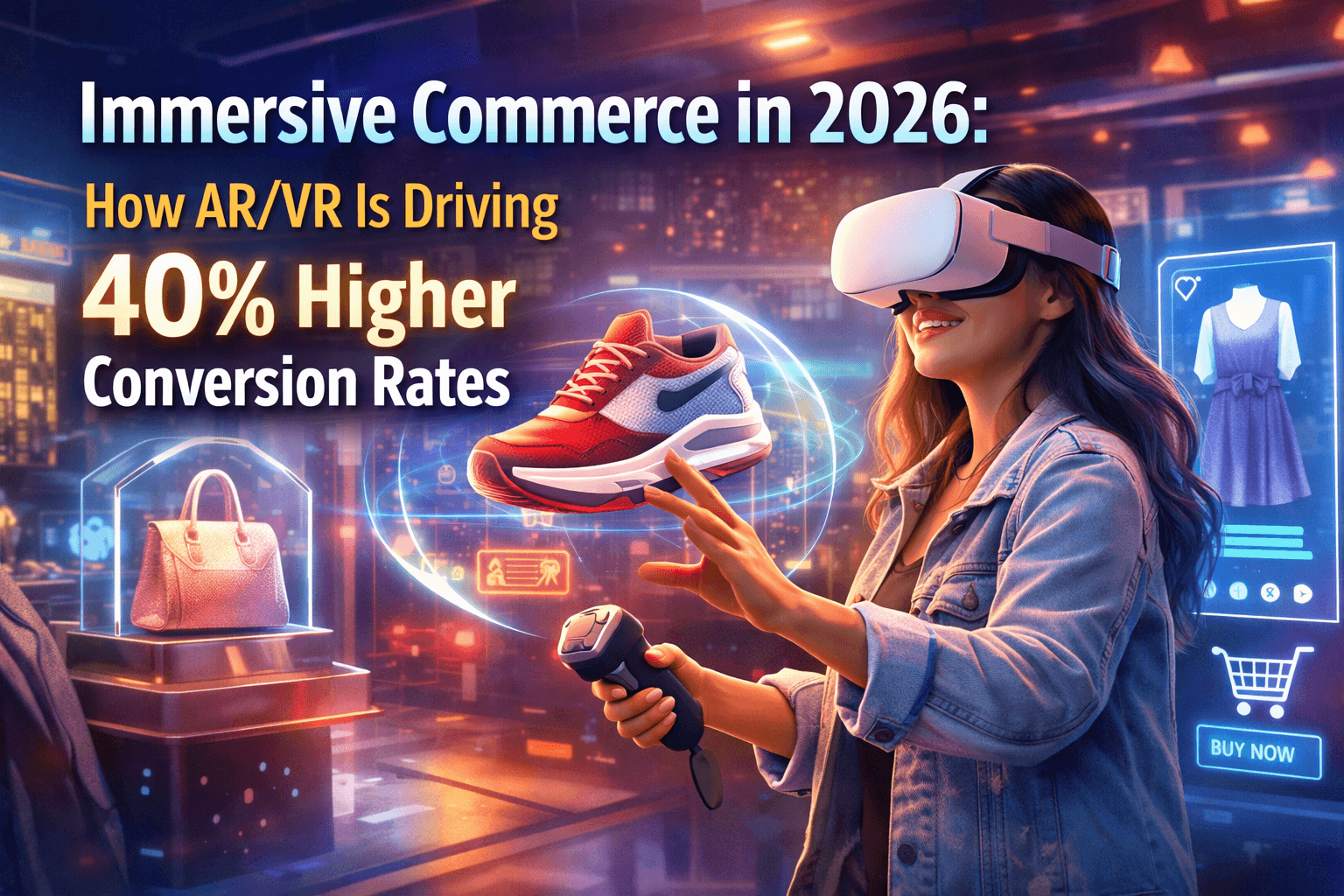
Immersive Commerce in 2026: 40% Conversion Boost with AR/VR

Listen to this article
What Is Immersive Commerce and Why 2026 Matters
Ever felt like online shopping could be... more? Like you're missing that 'real-world' feel? Well, get ready, because the future of online shopping is blasting off beyond those flat screens we're all used to. We're talking about immersive commerce, where e-commerce experiences get a serious upgrade thanks to Augmented Reality (AR) and Virtual Reality (VR) technologies. It's truly transforming how you and I interact with products and our favorite brands.
And here's the kicker: by 2026, this isn't just a cool new gadget; it's poised to fundamentally redefine retail as we know it, driving some seriously substantial gains in engagement and, yes, sales.
This isn't just a passing trend; it's a strategic imperative for any retailer looking to thrive. Industry reports are shouting from the rooftops about a major impact on retail by 2026, all driven by our demand as consumers for more engaging, more informative, and frankly, more exciting shopping journeys.
So, what does immersive commerce actually look like? Think about these game-changing aspects:
- AR-enhanced product visualization: Imagine placing a virtual sofa right in your living room before you buy it. Yep, that's it!
- Virtual try-on: Ever wished you could 'try on' clothes, accessories, or even makeup without leaving your couch? Now you can.
- VR shopping environments: Step into a virtual showroom or an entire store, browsing products in a truly interactive space.
- Personalized experiences: Your product discovery journey becomes uniquely yours, tailored through the magic of spatial computing.
This incredible evolution promises to finally bridge that frustrating gap between digital convenience and the tactile, hands-on experience of physical retail. The result? More informed purchasing decisions for us, and far fewer of those dreaded post-purchase regrets. The seamless integration of AR and VR creates genuinely compelling immersive shopping experiences that don't just grab customers' attention – they captivate and convert them.
AR/VR Market Growth Projections to 2026
If you're wondering where the AR/VR e-commerce market is headed, let me tell you: it's on a steep upward trajectory! And 2026? That's shaping up to be a pivotal year, marking significant growth and truly mainstream adoption. Businesses aren't just dabbling anymore; they're recognizing the tangible benefits of these technologies and moving beyond experimental phases straight into strategic, full-scale implementation.
At a high level, the market is expanding at an incredible pace. Just look at these numbers:
- Global AR e-commerce market: It was valued at USD 5.9 billion in 2024, and it's projected to skyrocket to USD 38.5 billion by 2030. That's massive!
- Compound Annual Growth Rate (CAGR): We're talking about a robust 35.8% growth from 2025 to 2030. That's not just growth; that's an explosion!
- AR in Retail Market: This specific segment is expected to reach USD 3.2 billion in 2026 alone.
This kind of expansion sends a clear, undeniable signal to the market: immersive technologies are no longer niche applications. They're quickly becoming essential tools for retail success.
Current Market Size and Shipment Trends
While the big picture is definitely growth, the AR/VR market has had its share of ups and downs. We actually saw AR/VR headset shipments take a bit of a dip in 2025. Think of it as a brief market contraction, a moment for the industry to catch its breath and refine things, before the anticipated rebound. This temporary slowdown, in a way, sets the stage for even stronger performance down the road.
2026 Growth Forecasts and Rebound Post-2025
Now, the projected rebound for AR VR headset shipments 2026? That's absolutely critical for seeing widespread adoption. As hardware becomes more accessible, more refined, and frankly, just plain better, we expect the market to really accelerate. This resurgence isn't just wishful thinking; it's driven by vastly improved user experiences and a much clearer value proposition for both consumers and businesses.
AR in Retail Market Expansion
Let's zoom in on a particularly exciting area: the AR in Retail Market. This segment is absolutely booming, growing at a fantastic 20% CAGR and set to hit USD 3.2 billion in 2026 alone! It's a key engine for the broader AR commerce market growth, as retailers are smartly leveraging AR for everything from letting you visualize products in your home to creating super interactive advertising. The practical, real-world applications of AR in retail are proving to be incredibly powerful tools for captivating customers.
Current Market Size and Shipment Trends
While the big picture is definitely growth, the AR/VR market has had its share of ups and downs. We actually saw AR/VR headset shipments take a bit of a dip in 2025. Think of it as a brief market contraction, a moment for the industry to catch its breath and refine things, before the anticipated rebound. This temporary slowdown, in a way, sets the stage for even stronger performance down the road.
2026 Growth Forecasts and Rebound Post-2025
Now, the projected rebound for AR VR headset shipments 2026? That's absolutely critical for seeing widespread adoption. As hardware becomes more accessible, more refined, and frankly, just plain better, we expect the market to really accelerate. This resurgence isn't just wishful thinking; it's driven by vastly improved user experiences and a much clearer value proposition for both consumers and businesses.
AR in Retail Market Expansion
Let's zoom in on a particularly exciting area: the AR in Retail Market. This segment is absolutely booming, growing at a fantastic 20% CAGR and set to hit USD 3.2 billion in 2026 alone! It's a key engine for the broader AR commerce market growth, as retailers are smartly leveraging AR for everything from letting you visualize products in your home to creating super interactive advertising. The practical, real-world applications of AR in retail are proving to be incredibly powerful tools for captivating customers.
How AR/VR Drives 40% Higher Conversion Rates
Alright, let's get to the most compelling reason to jump into immersive commerce: its direct, undeniable impact on sales. We're seeing AR/VR implementations achieve significantly higher conversion rates, absolutely blowing traditional e-commerce out of the water. This isn't just a nice-to-have; it translates directly into increased revenue and a sharper competitive edge for businesses.
So, how exactly does AR/VR work its magic to boost conversions? It's all about:
- Enhanced product understanding: You get a crystal-clear sense of size, scale, and how something will truly fit.
- Reduced uncertainty: Visualizing products in your actual space minimizes all that guesswork.
- Increased confidence: When you understand better, you make more assured purchase decisions. Simple as that!
- Emotional connection: Interactive experiences foster a deeper, more personal bond with the product.
And here's the headline: AR/VR enhanced product pages achieve a whopping 40% higher conversion rates compared to their traditional e-commerce counterparts. That's a substantial uplift that truly highlights the immense power of immersive experiences in driving purchasing behavior.
Mechanisms Behind Engagement and Purchases
AR and VR don't just make shopping 'nicer'; they create a richer, far more interactive journey. What's truly incredible is that users who engage with AR show 94% higher conversion rates than those who don't! That's a clear signal that people prefer engaging, interactive content. And this engagement isn't just superficial; it leads to a much deeper product exploration and, ultimately, a stronger intent to buy.
For instance, AR engagement can be a staggering 200% higher than non-AR content, with users demonstrating an 11x higher purchase likelihood. These aren't just numbers; they underscore the profound psychological impact that immersive visualization has on us as shoppers.
Metrics Beyond Conversions: Returns and Revenue
Beyond just skyrocketing conversion rates, immersive commerce also positively impacts other absolutely critical retail metrics. Here's a mind-blower: virtual try-on reduces returns by 30% and boosts sales by 20%! Talk about a win-win – you're increasing revenue and decreasing those costly returns. That makes AR/VR an incredibly powerful investment.
Think about retailers like Build.com, who've achieved 22% lower return rates just by implementing AR visualization. These aren't theoretical gains; these are tangible results that prove how immersive technologies solve real business problems, leading to better profitability and happier customers.
Traditional vs Immersive Commerce Comparison
Let's be honest: traditional e-commerce, with its static images and text, often leaves so much to our imagination. We're left guessing about size, fit, and how something will truly look. Immersive commerce, on the other hand, provides a dynamic, interactive experience that beautifully mimics real-world interaction. This direct comparison makes it crystal clear why AR VR e-commerce conversion rates are so much higher – because customers feel genuinely more informed and incredibly confident in their choices.
Mechanisms Behind Engagement and Purchases
AR and VR don't just make shopping 'nicer'; they create a richer, far more interactive journey. What's truly incredible is that users who engage with AR show 94% higher conversion rates than those who don't! That's a clear signal that people prefer engaging, interactive content. And this engagement isn't just superficial; it leads to a much deeper product exploration and, ultimately, a stronger intent to buy.
For instance, AR engagement can be a staggering 200% higher than non-AR content, with users demonstrating an 11x higher purchase likelihood. These aren't just numbers; they underscore the profound psychological impact that immersive visualization has on us as shoppers.
Metrics Beyond Conversions: Returns and Revenue
Beyond just skyrocketing conversion rates, immersive commerce also positively impacts other absolutely critical retail metrics. Here's a mind-blower: virtual try-on reduces returns by 30% and boosts sales by 20%! Talk about a win-win – you're increasing revenue and decreasing those costly returns. That makes AR/VR an incredibly powerful investment.
Think about retailers like Build.com, who've achieved 22% lower return rates just by implementing AR visualization. These aren't theoretical gains; these are tangible results that prove how immersive technologies solve real business problems, leading to better profitability and happier customers.
Traditional vs Immersive Commerce Comparison
Let's be honest: traditional e-commerce, with its static images and text, often leaves so much to our imagination. We're left guessing about size, fit, and how something will truly look. Immersive commerce, on the other hand, provides a dynamic, interactive experience that beautifully mimics real-world interaction. This direct comparison makes it crystal clear why AR VR e-commerce conversion rates are so much higher – because customers feel genuinely more informed and incredibly confident in their choices.
Key Hardware Advancements Enabling Mainstream Adoption
The widespread adoption of immersive commerce really hinges on one big thing: the incredible evolution of AR/VR hardware. By 2026, the advancements in these devices are making these technologies more accessible, more comfortable, and far more powerful for our everyday consumer use. This hardware progress isn't just a nice bonus; it's the absolute cornerstone for scaling immersive experiences to everyone.
So, what kind of exciting hardware developments are we talking about?
- Lighter, more powerful AR glasses: We're moving way beyond bulky headsets to sleek, wearable devices that feel natural.
- Improved mobile AR capabilities: Leveraging the tech you already have in your pocket – your smartphone – for accessible experiences.
- Enhanced spatial computing hardware: Devices that seamlessly blend digital content with your actual physical world.
- Increased processing power: This means more realistic, more complex, and truly jaw-dropping immersive environments.
These innovations are absolutely crucial for knocking down those previous barriers to entry, making immersive commerce a seamless, almost invisible part of your shopping journey.
Evolving AR/VR Devices for E-Commerce
AR/VR devices aren't just getting incrementally better; they're specifically evolving to perfectly cater to e-commerce needs. This means we're seeing better display resolutions, wider fields of view, and far more intuitive ways to interact. The ultimate goal? To make interacting with virtual products feel just as natural and informative as picking something up in a physical store.
By 2026, we're eagerly anticipating major advancements in lightweight AR glasses and cutting-edge spatial computing hardware. These devices aren't just about power; they're about comfort and integrating seamlessly into our daily lives. That's what will make sustained engagement with immersive shopping experiences not just possible, but truly enjoyable.
Mobile AR Accessibility Trends
And here's a crucial point: vastly improved mobile AR accessibility is democratizing immersive commerce, making it available to a massive audience without needing any specialized headsets. Think about it – most modern smartphones are now perfectly capable of delivering high-quality AR experiences, from letting you virtually try on new glasses to seeing a new couch in your living room. This dramatically lowers the barrier to entry, expanding the reach of immersive retail to literally millions of potential customers. It's a game-changer!
Evolving AR/VR Devices for E-Commerce
AR/VR devices aren't just getting incrementally better; they're specifically evolving to perfectly cater to e-commerce needs. This means we're seeing better display resolutions, wider fields of view, and far more intuitive ways to interact. The ultimate goal? To make interacting with virtual products feel just as natural and informative as picking something up in a physical store.
By 2026, we're eagerly anticipating major advancements in lightweight AR glasses and cutting-edge spatial computing hardware. These devices aren't just about power; they're about comfort and integrating seamlessly into our daily lives. That's what will make sustained engagement with immersive shopping experiences not just possible, but truly enjoyable.
Mobile AR Accessibility Trends
And here's a crucial point: vastly improved mobile AR accessibility is democratizing immersive commerce, making it available to a massive audience without needing any specialized headsets. Think about it – most modern smartphones are now perfectly capable of delivering high-quality AR experiences, from letting you virtually try on new glasses to seeing a new couch in your living room. This dramatically lowers the barrier to entry, expanding the reach of immersive retail to literally millions of potential customers. It's a game-changer!
Consumer Behaviors and Adoption Trends
Here's something fascinating: consumers like you and me are getting ready for immersive shopping experiences at an incredible pace! This signals a strong, undeniable demand for AR/VR integration in retail. Shoppers aren't just passively waiting; they're actively seeking out retailers who offer these advanced tools, showing a clear shift in what we prefer when we shop. This trend makes immersive commerce 2026 a truly consumer-driven reality.
What are these key consumer insights telling us? They reveal:
- High interest in AR shopping: A whopping 66% of shoppers are interested in using AR for their shopping needs. That's a huge segment!
- Increased loyalty: Even better, 71% of consumers say they shop more often at retailers who offer AR experiences. Loyalty, unlocked!
- Enhanced purchase confidence: AR genuinely helps us visualize products better, which dramatically reduces that nagging uncertainty.
- Desire for personalization: Immersive tech offers tailored experiences that truly resonate with our individual preferences.
These aren't just dry statistics; they highlight a clear, powerful consumer pull towards shopping journeys that are more interactive and deeply personalized. Retailers who truly embrace these preferences aren't just keeping up; they stand to gain significant market share.
Quick recap: Consumers aren't just open to AR/VR; they're actively preferring it. This preference translates directly into higher engagement and increased purchasing frequency, making it an absolutely critical factor for retail success in the coming years. The data suggests that immersive experiences are fast becoming a baseline expectation for many online shoppers. If you're not offering it, you might just be falling behind!
Retailer Case Studies and Enterprise Strategies
Leading retailers are already showing us the profound impact of immersive commerce, demonstrating how AR/VR translates into measurable, undeniable business success. These pioneers are truly setting the standard for enterprise AR VR retail adoption, proving the technology's value in real-world scenarios. Their smart strategies offer a fantastic blueprint for any business looking to innovate and stay ahead.
What are these successful implementations highlighting? It's a powerful list:
- Significant sales boosts: There's a direct, clear correlation between AR use and increased revenue. Cha-ching!
- Reduced return rates: Virtual visualization minimizes that dreaded buyer's remorse.
- Enhanced brand loyalty: Engaging experiences foster stronger, more meaningful customer connections.
- Competitive differentiation: This is your chance to truly stand out in a crowded e-commerce market.
These examples aren't just inspiring; they powerfully underscore the strategic advantage you gain by enthusiastically embracing immersive technologies.
Virtual Try-On and Showroom Success Stories
Let's talk about some real-world wins! We've seen it time and again: virtual try-on reduces returns by 30% and boosts sales by 20%. Take eyewear brand Chilli Beans, for example. They reported a fantastic 48% sales increase just by using WebAR for eyewear try-on. Imagine being able to see exactly how those new frames look on your face before you click 'buy' – it dramatically improves confidence!
And who can forget IKEA? They famously saw a 200% conversion increase after launching their AR app, letting users place virtual furniture right in their homes. Similarly, Houzz's 'View in My Room' feature showed AR engagement 200% higher than non-AR, leading to an incredible 11x purchase likelihood for AR users. These cases aren't just anecdotes; they powerfully validate the magic of visual context.
Fortune 500 Pilots and Implementations
It's not just the early adopters making waves; many Fortune 500 retailers are actively piloting and implementing AR/VR solutions right now. They're not just playing around; they're meticulously measuring ROI through metrics like reduced returns and increased Average Order Value (AOV). These massive enterprises understand that immersive commerce isn't just about novelty; it's about driving core business objectives. Their strategic investments signal a broader, fundamental shift in enterprise AR VR retail adoption, moving towards scalable, fully integrated solutions.
Virtual Try-On and Showroom Success Stories
Let's talk about some real-world wins! We've seen it time and again: virtual try-on reduces returns by 30% and boosts sales by 20%. Take eyewear brand Chilli Beans, for example. They reported a fantastic 48% sales increase just by using WebAR for eyewear try-on. Imagine being able to see exactly how those new frames look on your face before you click 'buy' – it dramatically improves confidence!
And who can forget IKEA? They famously saw a 200% conversion increase after launching their AR app, letting users place virtual furniture right in their homes. Similarly, Houzz's 'View in My Room' feature showed AR engagement 200% higher than non-AR, leading to an incredible 11x purchase likelihood for AR users. These cases aren't just anecdotes; they powerfully validate the magic of visual context.
Fortune 500 Pilots and Implementations
It's not just the early adopters making waves; many Fortune 500 retailers are actively piloting and implementing AR/VR solutions right now. They're not just playing around; they're meticulously measuring ROI through metrics like reduced returns and increased Average Order Value (AOV). These massive enterprises understand that immersive commerce isn't just about novelty; it's about driving core business objectives. Their strategic investments signal a broader, fundamental shift in enterprise AR VR retail adoption, moving towards scalable, fully integrated solutions.
Regional Markets and ROI Measurement
Here's an interesting twist: the growth of immersive commerce isn't a perfectly uniform global phenomenon. Certain regions are absolutely sprinting ahead, demonstrating accelerated adoption and investment. Understanding these regional dynamics, alongside having robust frameworks for measuring ROI, is absolutely crucial for strategically deploying AR/VR solutions. This isn't just about throwing tech at a problem; it's about ensuring your investments genuinely yield tangible returns for retailers.
So, what are these regional market insights telling us? They reveal:
- Asia Pacific leadership: This region is a massive growth driver for AR e-commerce, truly leading the charge.
- High CAGR: The Asia Pacific's AR e-commerce market is growing at an astounding over 35% CAGR from 2025-2030. That's incredible!
- Diverse adoption: Different regions show varying levels of readiness and unique use cases, so a one-size-fits-all approach won't work.
- Strategic investment: Focused efforts in these high-growth areas are how you maximize impact.
These regional differences are vital; they inform exactly where and how retailers should prioritize their immersive commerce initiatives. It's all about playing smart!
The bottom line: While global adoption is definitely on the rise, targeted regional strategies are absolutely key. For instance, the Asia Pacific region is a genuine hotspot for AR commerce market growth, making it a prime area for investment and innovation. Retailers can cleverly leverage this regional momentum to accelerate their own immersive strategies and really hit the ground running.
And let's not forget about the money! Measuring the Return on Investment (ROI) for AR/VR implementations is paramount for enterprise AR VR retail adoption. Those savvy Fortune 500 retailers? They're typically measuring ROI through things like reduced returns, increased AOV, higher conversion rates, and, of course, improved customer satisfaction. These are the quantifiable metrics that truly justify the investment and powerfully demonstrate the long-term value of immersive commerce. It's not just cool tech; it's smart business.
Challenges and Barriers to Wider Adoption
Okay, let's be real for a moment. Despite the immense, mind-blowing potential of immersive commerce, there are still some challenges and barriers that are currently slowing down its wider adoption. Addressing these hurdles isn't just important; it's absolutely essential for us to truly realize the full promise of AR/VR in retail, especially as the market matures towards 2026.
What are these primary challenges? Let's break them down:
- Hardware accessibility: Not everyone owns a fancy AR/VR headset, right?
- User experience (UX) hurdles: Think motion sickness, confusing interfaces, or just a steep learning curve.
- Content creation costs: Developing those high-quality 3D assets can be quite expensive.
- Interoperability: We need seamless experiences across all sorts of different platforms and devices.
Overcoming these obstacles isn't just a good idea; it's critical for truly mainstreaming immersive shopping. The good news? The industry is on it!
2025 Shipment Dips and UX Hurdles
Remember those 2025 AR/VR shipment dips we talked about? They were partly due to a market contraction, reflecting some real challenges in getting consumers to fully embrace the tech. But it's not just about hardware availability; some key UX hurdles still persist. Think about it: issues like motion sickness in VR shopping environments, overly complex navigation, and just the general learning curve that comes with any new technology. Simplifying these experiences is absolutely crucial if we want broader consumer acceptance. We need it to feel effortless!
### Overcoming Adoption Barriers
So, how are we going to overcome these barriers? The industry is laser-focused on several key areas. This includes developing far more intuitive interfaces, creating lightweight and super comfortable AR glasses (no more bulky headsets!), and continually improving mobile AR capabilities to leverage the devices we already own. Standardizing content creation and ensuring seamless integration with existing e-commerce platforms will also be vital. The big goal? To make immersive shopping experiences as effortless, enjoyable, and natural as traditional browsing. It's all about making it *easy* for you to dive in!
2025 Shipment Dips and UX Hurdles
Remember those 2025 AR/VR shipment dips we talked about? They were partly due to a market contraction, reflecting some real challenges in getting consumers to fully embrace the tech. But it's not just about hardware availability; some key UX hurdles still persist. Think about it: issues like motion sickness in VR shopping environments, overly complex navigation, and just the general learning curve that comes with any new technology. Simplifying these experiences is absolutely crucial if we want broader consumer acceptance. We need it to feel effortless!
### Overcoming Adoption Barriers
So, how are we going to overcome these barriers? The industry is laser-focused on several key areas. This includes developing far more intuitive interfaces, creating lightweight and super comfortable AR glasses (no more bulky headsets!), and continually improving mobile AR capabilities to leverage the devices we already own. Standardizing content creation and ensuring seamless integration with existing e-commerce platforms will also be vital. The big goal? To make immersive shopping experiences as effortless, enjoyable, and natural as traditional browsing. It's all about making it *easy* for you to dive in!
Future AI Integration in Immersive Platforms
Get ready for the next level! The absolute next frontier for immersive commerce involves the seamless, powerful integration of Artificial Intelligence (AI) into AR/VR platforms. This isn't just adding a feature; this powerful combination is going to unlock unprecedented levels of personalization and efficiency, further solidifying the incredible impact of immersive commerce 2026 and far beyond. Think of AI as the brilliant intelligence layer, making all those immersive experiences smarter, more responsive, and truly magical.
So, what exactly will AI's role be in this immersive commerce revolution? It's going to bring us:
- Hyper-personalization: Imagine product recommendations and virtual environments tailored *just for you*.
- Intelligent virtual assistants: Smart guides helping you navigate complex decisions, almost like having a personal shopper.
- Dynamic content generation: Creating personalized AR/VR experiences on the fly, adapting to your every move.
- Predictive analytics: Anticipating your needs and preferences before you even know them yourself!
This integration isn't just a promise; it's set to elevate the entire shopping journey, making it far more intuitive, effective, and frankly, delightful.
Why this matters: This isn't just cool tech for tech's sake. AI integration with AR/VR is projected to enhance personalization so much that it could boost revenue by a fantastic 10-15%! That's a significant uplift that truly demonstrates the economic power of combining these cutting-edge technologies. The synergy between AI and spatial computing is going to create retail environments that are highly adaptive and incredibly responsive.
This future vision for AI spatial computing commerce will allow immersive platforms to truly understand user intent, adapt environments in real-time, and offer shopping journeys that are genuinely bespoke. Imagine a virtual showroom that completely reconfigures itself based on your preferences, or an AR assistant that actually learns your style over time. This intelligent layer is what will drive the next, exhilarating wave of innovation in immersive retail. It's going to be wild!
Conclusion
So, what's the big picture for immersive commerce 2026? It's crystal clear: we're witnessing a truly transformative shift in how we, as consumers, interact with brands and products online. The convergence of AR/VR technologies with smart, strategic retail applications isn't just *enhancing* the shopping experience; it's fundamentally *redefining* it. From driving significantly higher conversion rates to slashing those costly returns, immersive platforms offer tangible, measurable benefits that are simply too substantial for any forward-thinking retailer to ignore.
Let's quickly recap the game-changers:
- Immersive commerce, powered by AR/VR, is set to significantly boost conversion rates by a fantastic 40% by 2026.
- The AR e-commerce market is experiencing rapid, exciting growth, with a strong rebound expected in AR/VR headset shipments in 2026.
- Retailers are seeing substantial ROI through virtual try-on, reduced returns, and dramatically increased customer engagement.
- Incredible hardware advancements and vastly increased mobile AR accessibility are paving the way for mainstream adoption – for everyone!
- The future of immersive commerce will be further enhanced by brilliant AI integration, enabling hyper-personalized shopping experiences that feel truly magical.
As hardware continues its amazing evolution and AI integration becomes even more sophisticated, that line between physical and digital retail is going to blur even further. Retailers who enthusiastically embrace these innovations won't just meet evolving consumer expectations; they'll unlock entirely new avenues for growth and build incredible customer loyalty in the years to come. The era of truly immersive shopping isn't just coming; it's already here, and it's rapidly accelerating towards a more engaging, more efficient, and frankly, more exciting future for us all!
Never miss another article
Highly curated content, case studies, Magentic updates, and more.